Lesson 4-4 · The Driver
Lesson 4-4 · The Driver
Teacher mode is on. Toggle it off (bottom-right) to preview the student view.
The planner is real. Now the driver stub goes. At each intersection on the path, the robot does two things: turn to face the next intersection, then drive to it. Today you write the loop that does that and the function that works out which way to face. Turning and driving stay stubs for now, so every move shows up as printed lines.
Learning Objectives
By the end of this lesson you will be able to:
- Break driving a path into two steps at each intersection: turn, then drive
- Read one item of a list or one part of a tuple by its index, counting from 0
- Write
get_desired_heading(position, next_pos), which turns a one-step move into a heading (0 = N, 1 = E, 2 = S, 3 = W) - Write the real
drive_path()loop, with stubs for turning and driving - (Optional) Catch a mistake early by raising an error when a function is asked something it can't answer
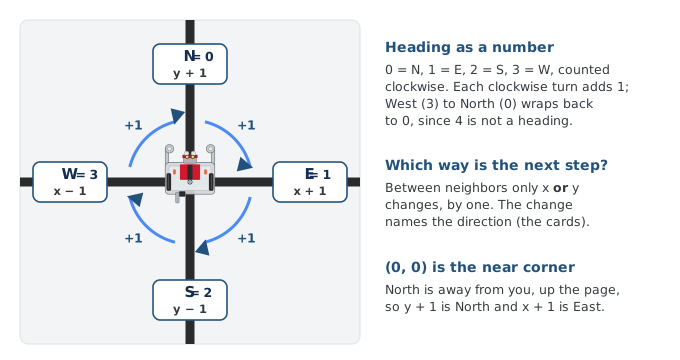
Heading is a number
Since Lesson 4-1 the program has carried a robot_heading that never changed. Now it gets
used. The four directions are numbered clockwise from North:
| Heading | 0 | 1 | 2 | 3 |
|---|---|---|---|---|
| Direction | North | East | South | West |
Numbers are easy to do arithmetic on (a clockwise quarter turn adds 1), but 0 in a
printout is hard to read. So the program needs a way to turn 0 into N and 2 into S.
Picking one item: indexing
Put the four letters in a list, in heading order:
HEADING_NAMES = ["N", "E", "S", "W"]
Every item in a list has a position number, its index, counting from 0. Square brackets after the name pick one item out:
print(HEADING_NAMES[0])    # N
print(HEADING_NAMES[2])    # S
heading = 3
print(HEADING_NAMES[heading])    # W
The headings were numbered 0 to 3 so that a heading is the index of its own letter.
A tuple is indexed the same way. For a position, index 0 is x and index 1 is y:
next_pos = (2, 3)
print(next_pos[0])    # 2 -> x
print(next_pos[1])    # 3 -> y
For a position you'll usually want both numbers, so this program keeps unpacking them,
as the planner does. Indexing is for picking one item out of many. Asking for an index that isn't
there, like HEADING_NAMES[4], stops the program with an IndexError.
What does this print?
path = [(1, 0), (2, 0), (2, 1)]
last = path[2]
print(last[1])
Which way to face?
Between two adjacent intersections, either x changes by one or y changes by one, never both. That's four cases, one per compass direction:
| Coordinate change | Direction | Heading |
|---|---|---|
| y +1 (up, away from you) | North | 0 |
| x +1 (right) | East | 1 |
| y −1 (down, toward you) | South | 2 |
| x −1 (left) | West | 3 |
The part to keep straight: x comes first in the tuple, but North and South change the second number. North is away from you, so moving North makes y bigger.
The robot moves from (2, 3) to (3, 3). Which direction is that, and what heading?
get_desired_heading(position, next_pos) works out that table. It unpacks both
positions, as the planner did, then finds the one number that changed. Four if lines,
one per row: if next_y is bigger than y, the move is North; if next_x is bigger than
x, it's East; and the same with "smaller" for South and West.
This lesson's skeleton
Put these above the drive_path() function: the list of letters, the function you
write, a quick test for it, and two new stubs.
HEADING_NAMES = ["N", "E", "S", "W"]    # HEADING_NAMES[2] -> "S"

def get_desired_heading(position, next_pos):
    """Return the heading (0-3) that points from position to
    next_pos, which must be one step away."""
    # 1. unpack position into x, y and next_pos into
    #    next_x, next_y
    # 2. one if per row of the table, each returning its
    #    heading. North is: if next_y > y: return 0
    # 3. (optional) none matched: raise ValueError, naming
    #    both positions -- see "Catching mistakes early"
    pass

def test_headings():
    for next_pos in [(0, 1), (1, 2), (2, 1), (1, 0)]:
        heading = get_desired_heading((1, 1), next_pos)
        print("(1, 1) to", next_pos, ":", heading, HEADING_NAMES[heading])

def turn_to(current_heading, desired_heading):
    """STUB: pretend the robot turned. Lesson 4-5
    replaces it."""
    print("turning: from", HEADING_NAMES[current_heading],
          "to:", HEADING_NAMES[desired_heading])
    return desired_heading

def fake_track_to_intersection():
    """STUB for track_to_intersection(): print instead of
    driving. Lesson 4-6 swaps in the real one."""
    print("tracking to intersection")
Then fill in the drive_path() stub you already have. Its loop gets four new steps, and
the docstring changes:
def drive_path(path, current_position, current_heading):
    """Turn and drive through every intersection in path;
    return the final position and heading."""
    for next_pos in path:
        # 1. desired_heading: which way to face next_pos
        # 2. print("moving: from", current_position, "to:", next_pos,
        #          "heading:", HEADING_NAMES[desired_heading])
        # 3. turn: current_heading = turn_to(...)
        # 4. drive there: fake_track_to_intersection()
        current_position = next_pos     # the robot is there now
    return current_position, current_heading
turn_to() hands back the new heading, so step 3 keeps current_heading up to date the
same way the main program keeps robot_position up to date.
One more line changes. In test_delivery(), make the new position: print show the
letter:
        print("new position:", robot_position,
              "heading:", HEADING_NAMES[robot_heading])
Activity · Write it, test it, run it
Step 1 · get_desired_heading()
Write its body from the outline. Work out the four answers for test_headings() from
the table first: from (1, 1) to (0, 1), (1, 2), (2, 1) and (1, 0). Set the run line to
test_headings() and run it.
What correct looks like: four lines whose heading numbers and letters match your four answers.
Step 2 · The drive_path() loop
Fill in steps 1 to 4 of the loop. Set the run line to test_delivery() and run it.
What correct looks like: under each path, one moving: line per intersection in it,
each followed by a turning: line and tracking to intersection. Each move starts where
the last one ended, and its letter matches the table: Leg 1 is E, E, N, N, N. Each
turning: starts from the heading the one before it ended on. The last line says
new position: (0, 0) heading: S: the last move of the run goes South.
Going from (1, 3) to (1, 2), what does get_desired_heading() return?
Wrap-up
- What two steps happen at each intersection? (Turn to face the next one, then drive to it.)
- Between adjacent intersections, what can change? (x or y, by one: four cases, four headings.)
- What does
HEADING_NAMES[heading]do? (Picks the item at that index, counting from 0: the heading's letter.) - Why does
drive_path()writecurrent_heading = turn_to(...)? (turn_to()hands back the new heading; assigning it is the only waydrive_path()keeps it.)